
Sovereign AI:choose your dependenciesrather than pretendyou can eliminate them
Behind the announcement of a gigawatt of European compute lies a question for every company: what do we depend on, what can we still change, and at what cost?
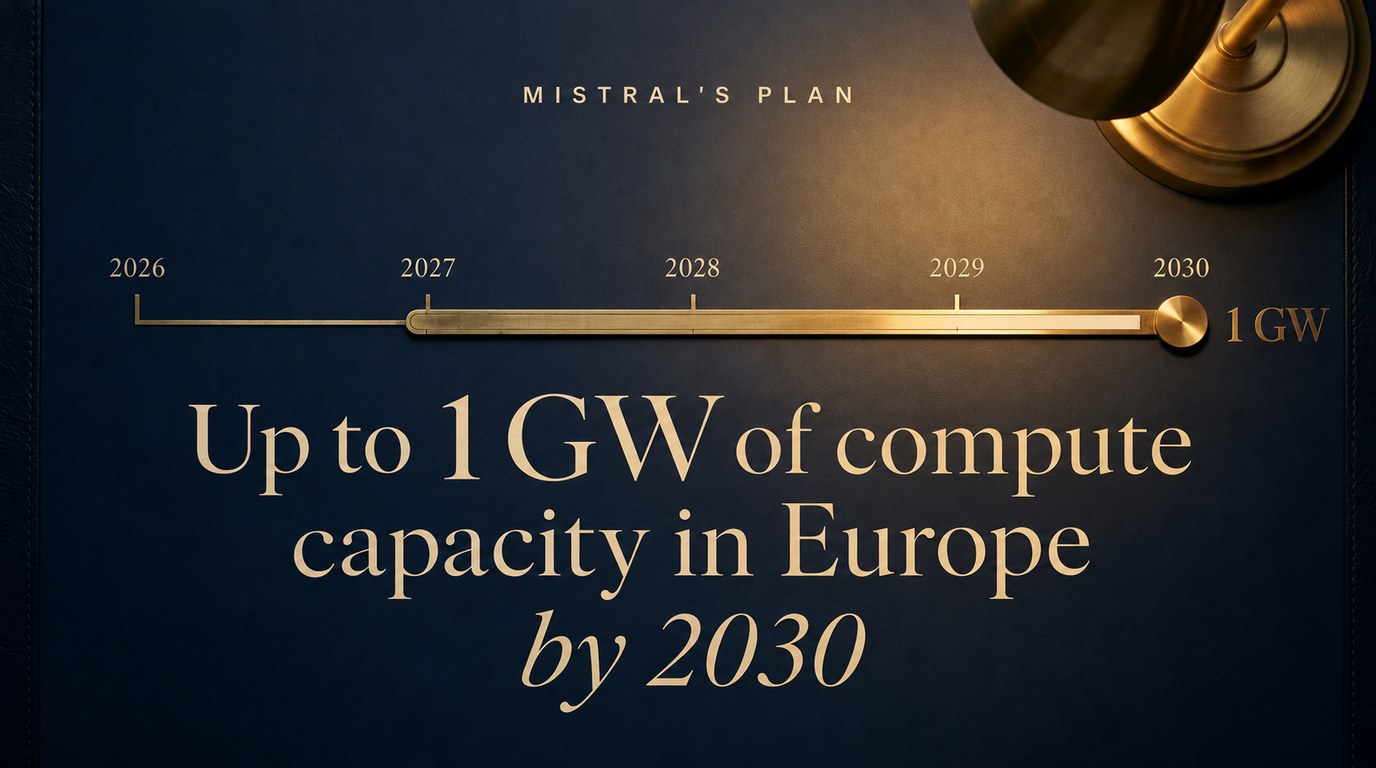
On 11 August 2026, Mistral announced the next phase of its European infrastructure plans. Three facts: inference can now run under regional control, the platform will host third-party open models, and long-term commitments are meant to support up to 1 GW of compute capacity in Europe by 2030.
The subject looks technical: compute capacity, data centres, industrial policy. Yet it is closer to your company than it seems.
Once AI enters your operations, choosing a model is no longer enough. You are also choosing the infrastructure, service terms, where processing takes place and which suppliers you will rely on.
Sovereignty is not the absence of dependencies. It is the ability to know them, choose them and change them.
What the gigawatt figure leaves out
Mistral is not just promising more power. With its regional inference endpoints, you can choose whether inference runs in Europe or the United States. It adds a priority service tier, with availability commitments for critical uses.
Why does this matter to you? Because criticality changes everything. If an AI service helps you rephrase a document, an outage is a nuisance. If the service handles customer enquiries or informs decisions, an outage can bring that work to a halt. The questions to ask change accordingly: will the service be available when you need it? Where will your data be processed? What happens if the terms change?
Model quality is no longer enough. What counts are the conditions under which your company will be able to depend on it.
Regional processing still creates dependencies
Processing your data in Europe is real progress. It is not a guarantee of independence. Mistral says so itself: limited transfers to certain subprocessors remain possible, and regional processing does not make the governance of the platform regional.
In practice, a “European” infrastructure still rests on a chain of suppliers, services and contracts. The right question is therefore not “are we independent?” but “do we know whom we depend on, and what can we change if we need to?”

The model itself is becoming more interchangeable
Mistral will open its platform to third-party models, starting with Z.ai’s GLM-5.2. Same infrastructure, same controls, same service commitments. The model becomes a part you can replace without rebuilding everything.
For your business, the choice is practical. A document assistant, an analysis tool, a high-volume process: each application may need a different model, depending on the balance of cost, speed and quality. That still requires your system to be designed around a need, not around a supplier.
Replacing a component designed to be swapped out is a routine change. Replacing the part everything was built around is a migration. The difference is decided at design time.

Long-term commitments reveal several forms of dependency
To fund this infrastructure, Mistral relies on multi-year commitments from companies and institutions. The logic is sound: major investments require predictable demand.
For customers, there is a trade-off. A long-term commitment secures access to a critical resource. It also reduces your freedom to change course. A dependency is not only technical: it can be contractual (what happens if you leave before the term ends?) or economic (what becomes of your budget if prices move with your usage?).
Accepting a dependency is legitimate. Assess it before signing the contract.

Four capabilities for managing dependencies
The right question is not “is this solution fully independent?”. None is. It is: “is this a dependency we can manage?” Four capabilities let you check.
Understand
Know exactly which models, data, services and suppliers are involved in each use.
Choose
Weigh the value, actual costs, acceptable risks and your organisation's constraints.
Monitor
Track what changes over time: costs, availability, usage, contract terms.
Adapt
Keep a real option to replace a model, a supplier or a component when your needs change.
A dependency that is known, assessed and contracted is acceptable. A dependency discovered at the moment it becomes a problem no longer is.
What this means for SMEs
An SME will not reserve megawatts of compute, but it faces the same questions on a smaller scale.
Controls should grow with your dependence on a service, not ahead of it.
What changes in practice
When a team starts relying on AI in its daily work, it stops being a tool and becomes a dependency: a business assistant built on an external API, a document repository hosted by a single provider, a workflow whose cost rises with usage.
What to look for
Four points are enough to start: who you really depend on, where your data flows, which components would be hard to replace, and what can stop for a day without consequence, as opposed to what cannot.
How far to go
You can start without a multi-provider architecture. That would often add complexity without addressing the dependency that matters. An up-to-date inventory, a clear exit clause and a known alternative for critical uses give you a proportionate level of control.
Why the gigawatt matters to businesses
Mistral’s project matters for Europe: it strengthens an industrial capacity on which AI directly depends. For organisations, its reach is wider. AI is becoming operating infrastructure, in the same way as IT or energy.
A model’s performance is then no longer enough to decide. You have to look at the environment that will let you use it, monitor it, fund it and replace it.
What will this solution make us rely on, and can we change that if our needs change?